

Which LEGO Star Wars UCS Set Is the Best Value for Money?

Here's the counterintuitive math on LEGO Star Wars UCS sets: the $1,000 Death Star has a better cost-per-piece than most $300 sets in the lineup. Price and value are not the same number here, and the gap between them is wide enough to matter.
The LEGO Star Wars Ultimate Collector Series spans $200 to $999.99. That spread covers very different builds – a 1,500-piece walker, a 9,000-piece diorama, and ships that stretch over a meter long. Anyone spending $600+ deserves a clearer framework than "it's expensive, so it must be good," or the reverse.
Cost per piece, exclusive minifigure worth, retirement timeline, and display footprint vs. price paid are the four criteria that do the actual work.
Why Cost Per Piece Misleads More Than It Helps?
Raw brick count is the most common shorthand for LEGO value, and the most consistently misleading one.
Large moulded parts inflate piece counts without adding proportional build time. A single ship hull piece covers the same surface area as fifty small tiles. Two sets at the same piece count can feel completely different once you're sitting at the table with the bags open.
Minifigure rosters fall entirely outside the cost-per-piece calculation, yet they drive a disproportionate share of secondary-market value. A figure that only appears in one set can sell for $30–$80 on BrickLink on its own. A set with two exclusive, in-demand characters holds its value after retirement in ways that a set with six generic stormtroopers doesn't. That gap compounds once production stops.
Use cost per piece as a filter, not a verdict.
How to Read a UCS Set Before You Buy It?
➨ Piece rate vs. mold density. A low cost-per-piece means more when the pieces are varied and technically demanding. The Venator's 5,374 pieces involve detailed greebling across a 43-inch hull, interior sub-builds, and a microscale Republic Gunship nested inside the hangar. That's structurally different from the same count padded with repetitive 1x2 plates.
➨ Exclusive minifigures and their staying power. Not all exclusives hold their value equally. When Captain Rex shipped exclusively with the Venator in 2023, his BrickLink price hit £81. By mid-2024, after LEGO re-released the identical figure in a £12 microfighter, that price dropped to £15. Admiral Yularen, who hasn't been re-released, remains the genuinely scarce figure in that set. Before factoring an "exclusive" figure into value calculations, verify it hasn't since appeared in a cheaper set.
➨ Retirement timeline and production run length. The Millennium Falcon (75192) has been in production since September 2017, an unusually long run for a UCS set. LEGO Star Wars sets have averaged 11% annualized growth across retired sets, with UCS sets above $300 averaging 12%. That growth starts the day production stops, not the day you buy. Sets with confirmed December 2026 retirement dates are on a known clock.
➨ Display footprint as a real constraint. The Venator stretches 43 inches long and 21 inches wide. The Falcon needs roughly 33 inches in each direction. The Death Star stands 28 inches tall and 31 inches wide. These aren't just specs; they're shelf decisions. A set bought and stored in a box delivers zero value as a display piece, which is most of what UCS sets are.
LIGHT UP YOUR LEGO® WORLD
Upgrade your LEGO® creations with premium LED light kits designed to highlight every detail. Simple installation, broad compatibility, and the perfect way to make any build stand out.


Five Sets, Five Value Verdicts
Jango Fett's Firespray (75409)
$299.99 | 2,970 pieces | ~$0.10 per piece
No UCS set on shelves today beats the Firespray on pure cost-per-piece. At roughly 10 cents per brick, it clears the Falcon, the Death Star, and the Venator by a meaningful margin.
The finished model is 17.5 inches long and 15.5 inches wide. Landing mode sits flat on a surface; flight position uses the included stand and keeps the wings level as the model tilts, a mechanical detail that earns its place. The cockpit section is removable, and the seismic charge compartment and adjustable cannons function as they should.
Jango Fett and a young Boba Fett are both confirmed to be exclusive to this set. Jango's armor printing and the new rangefinder piece are among the stronger minifigure additions in the recent UCS catalog. Both figures have no cheaper alternative on shelves right now, which matters for long-term secondary-market value.
At $300 with the lowest piece rate in the lineup and two exclusive characters with no re-release history, it ranks among the best LEGO UCS sets for anyone starting a display collection.

Venator-Class Republic Attack Cruiser (75367)
$649.99 | 5,374 pieces | ~$0.12 per piece
At 43 inches long and 21 inches wide, the Venator is the longest LEGO Star Wars UCS set on shelves right now. It's also the set most frequently cited by collectors and reviewers as the clearest overall value in the premium tier.
The white-and-red Clone Wars color scheme is one of the few UCS ships that doesn't blend into a gray shelf. The build involves dense greebling across a massive surface area, with the microscale Republic Gunship nested inside the hangar bay as an Easter egg for anyone who opens it up.
One caveat worth knowing before checking the minifigure count. Only Admiral Yularen is a genuinely permanent exclusive. Captain Rex shipped as an exclusive in 2023, but LEGO released the identical figure in a $12 microfighter in 2024, collapsing his BrickLink value from £81 to £15. Yularen remains a valuable figure in this set.
Two minifigures for a $650 ship is a thin roster, and no opening hangar is a real omission. Released in October 2023, the Venator has a confirmed December 2026 retirement date alongside the Falcon. BrickRanker projects 23% appreciation within two years of retirement, with an upper estimate of 33%.

Millennium Falcon (75192)
$849.99 | 7,541 pieces | ~$0.11 per piece
The Falcon has been in production since September 2017. Its retirement has been extended multiple times, from 2020 to 2025, to its confirmed December 31, 2026, end date. That near-decade run means production volumes are much higher than a typical UCS release, which is reflected in the current secondary-market price of roughly $666, sitting below retail rather than above it.
That production history changes the post-retirement appreciation story for 75192. The original UCS Falcon (10179) sold for two and a half years before retiring in 2010 and has since appreciated roughly 300%, from $499.99 retail to a current average sale price of roughly $2,000. The 75192's longer run means more sealed copies exist in the world, which moderates secondary-market premiums. For display buyers, none of that matters anyway.
For $849.99, you get a 33-inch model with removable hull panels revealing the full interior: cockpit, dejarik table, cargo hold, hyperdrive, gunner stations. Eight minifigures span both eras, including Han Solo, Chewbacca, Princess Leia, C-3PO, older Han Solo, Rey, Finn, and BB-8. The sensor dish and crew swap out to build either the classic trilogy or sequel-era configuration.
Retail is the floor price. December 31, 2026, is the last day to buy it there.

UCS Death Star (75419)
$999.99 | 9,023 pieces | ~$0.11 per piece
The price looks extreme until you work through what's actually included.
At 11 cents per piece, the Death Star's brick rate matches the Falcon's and beats most smaller UCS sets. The 38 minifigures include 7 brand-new exclusive characters making their first LEGO appearance: Admiral Motti, General Tagge, Galen Erso, the Imperial Dignitary (Sim Aloo), the droid 5D6-RA-7, the astromech R3-T6, and the Hot Tub Stormtrooper. Those figures carry a combined BrickRanker value of $741, meaning the minifigure roster alone accounts for the majority of the set's secondary-market value at current prices.
The design is a cross-section diorama, not a ship model. That's a meaningful distinction for buyers expecting a sphere. Inside you'll find the trash compactor, Princess Leia's cell, the Emperor's throne room, the hangar bay with a Lambda-class shuttle, and the superlaser control room, covering nearly every scene from the original trilogy in a footprint 28 inches tall and 31 inches wide.
Released October 2025 with no confirmed retirement date, this set has the longest runway of any in the comparison. UCS Star Wars sets have averaged 12% annual appreciation post-retirement; with 38 figures including 7 exclusives, this one carries the strongest minifigure-driven value argument in the current lineup. For a deeper look at how the Death Star has evolved across LEGO releases, see our guide to LEGO Star Wars Death Star Sets.

AT-ST Walker (75417)
$199.99 | 1,513 pieces | ~$0.13 per piece
The AT-ST has the highest cost-per-piece in this comparison. Smaller sets consistently carry a size premium because licensing, design, and packaging costs spread across fewer pieces, and that's a structural pattern across the UCS lineup, not a knock on this specific set.
The $200 price holds up. The model is accurate, stable, and displays well on a standard bookshelf without requiring custom shelving or a dedicated display table. The top hatch opens to reveal a fully detailed two-person cockpit. The head rotates, the laser cannons adjust, and the viewports open and close. One exclusive AT-ST Driver minifigure is included, with the Imperial crest printed on the arms.
The AT-ST was first produced as a UCS set in 2006 (10174, 1,068 pieces). This 2025 version adds 445 pieces to that count and incorporates substantially improved build techniques. At roughly two and a half hours, it has the shortest build time of any set in this comparison, making it a natural first UCS build for someone testing out display-focused collecting.

The Full UCS Value Scorecard
How to Get the Full Display Value Out of a UCS Build?
A UCS set without lighting covers only part of what makes it worth displaying.
The Death Star's interior rooms were designed at minifigure scale specifically for close examination. The throne room, the trash compactor, and Leia's cell each tell a scene; without lighting, that depth reads as shadow from across a room. The Venator's 43-inch hull has running light channels built into its design that serve no visual purpose until lit. The Falcon's cockpit, visible through the detachable canopy, is the natural focal point of the model and the one that changes most dramatically with directional LEDs pointed into it.
LeLightGo produces custom LED light kits sized to specific LEGO Star Wars sets, with plug-and-play installation, no permanent modifications to the model, and USB or battery power options. Browse the full range of LEGO Star Wars light kits.
Frequently Asked Questions
The Venator and the Falcon are similar prices. Which one should I actually buy?
Measure your shelf first. The Falcon needs 33 inches in each direction; the Venator needs 43 inches of uninterrupted length. Both retire in December 2026. The Venator delivers more display scale per dollar; the Falcon has stronger franchise recognition and resale demand.
Does buying on sale during May the 4th or Black Friday actually save money on UCS sets?
Discounts on UCS sets run 10–15%, and not every set participates. For the Death Star, AT-ST, and Firespray, which have no confirmed retirement date, a sale is worth waiting for for the Falcon and Venator, retiring December 2026, waiting risks missing retail entirely for $85 in savings.
I already own the Falcon. Which UCS set pairs best with it on display?
For an original trilogy shelf, the Death Star works best. Same era, and the diorama format contrasts well with the Falcon's ship profile. For a prequel section, the Venator. For a ground-side Imperial complement, the AT-ST.
Are UCS sets worth buying if I plan to build them once and display them, not resell?
Yes. The Venator runs 12–15 build hours; the Falcon runs 20–40; the Death Star is a full weekend. That build time is part of what you're paying for. Buy whichever era you care about most.
Why does the AT-ST cost more per piece than the Falcon?
Fixed costs like licensing, tooling, and packaging spread across fewer pieces in smaller sets, raising the per-brick rate. It's a consistent pattern across the UCS lineup, not specific to the AT-ST.
Featured Product

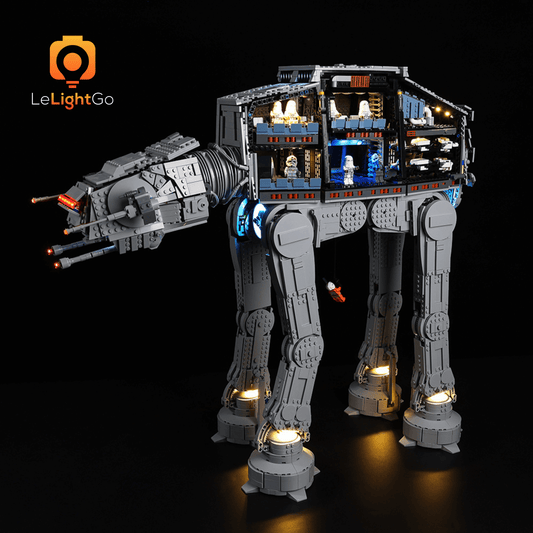
Light Kit For AT-AT 75313 Light Kit For AT-AT 75313
Keep Reading

One Piece LEGO Sets First Wave Overview
When LEGO and Netflix launched seven One Piece sets on August 1, 2025, the release marked the first time LEGO built a product line around an anime property. Seven One...
One Piece LEGO Sets First Wave Overview
When LEGO and Netflix launched seven One Piece sets on August 1...

LEGO X-Files Set 2026 Review and Build Details
The X-Files premiered on a Friday night in September 1993, and the show waited 33 years to arrive in brick form. Set 21369 reached LEGO Insiders on August 1, 2026,...
LEGO X-Files Set 2026 Review and Build Details
The X-Files premiered on a Friday night in September 1993, and ...

Why Fans Keep Buying the LEGO Mineral Collection?
LEGO priced set 21362 at $59.99 for 880 pieces, which works out to about 6.8 cents per piece and makes it one of the few 18+ display sets LEGO...
Why Fans Keep Buying the LEGO Mineral Collection?
LEGO priced set 21362 at $59.99 for 880 pieces, which works o...